Short answer: PCI DSS 4.0.1 requirement 6.4.3 asks you to approve, protect and list every script that runs on your payment page, with a written reason for each. Requirement 11.6.1 asks you to detect unauthorized changes to those scripts and security headers at least weekly. Both have applied since March 31, 2025. Magento gives you building blocks, but for Magento PCI compliance the inventory and monitoring are still your job.
Picture a compliance call that seems routine. The vulnerability scan passed. The SSL certificate is fine. Then the auditor asks a simple question: “Can you send me the list of every script that loads on your payment page, and why each one is there?”
Silence. Somebody opens the checkout in a browser and starts counting. Analytics. A chat widget. Two marketing pixels. A review badge. A script nobody recognizes, added by an agency three years ago.
The scene is illustrative, but the gap is common. Most stores never needed this list before. Since March 31, 2025, many of them do.
Why payment page scripts matter
Card-skimming attacks on online stores rarely break into the payment gateway. They add a few lines of JavaScript to the checkout page, which copy card details as the shopper types and send them elsewhere. The store keeps taking orders, and the theft can run for weeks before anyone notices.
The two new requirements exist to stop exactly that. One controls which scripts are allowed to run. The other notices when the page changes.
The two rules in plain English
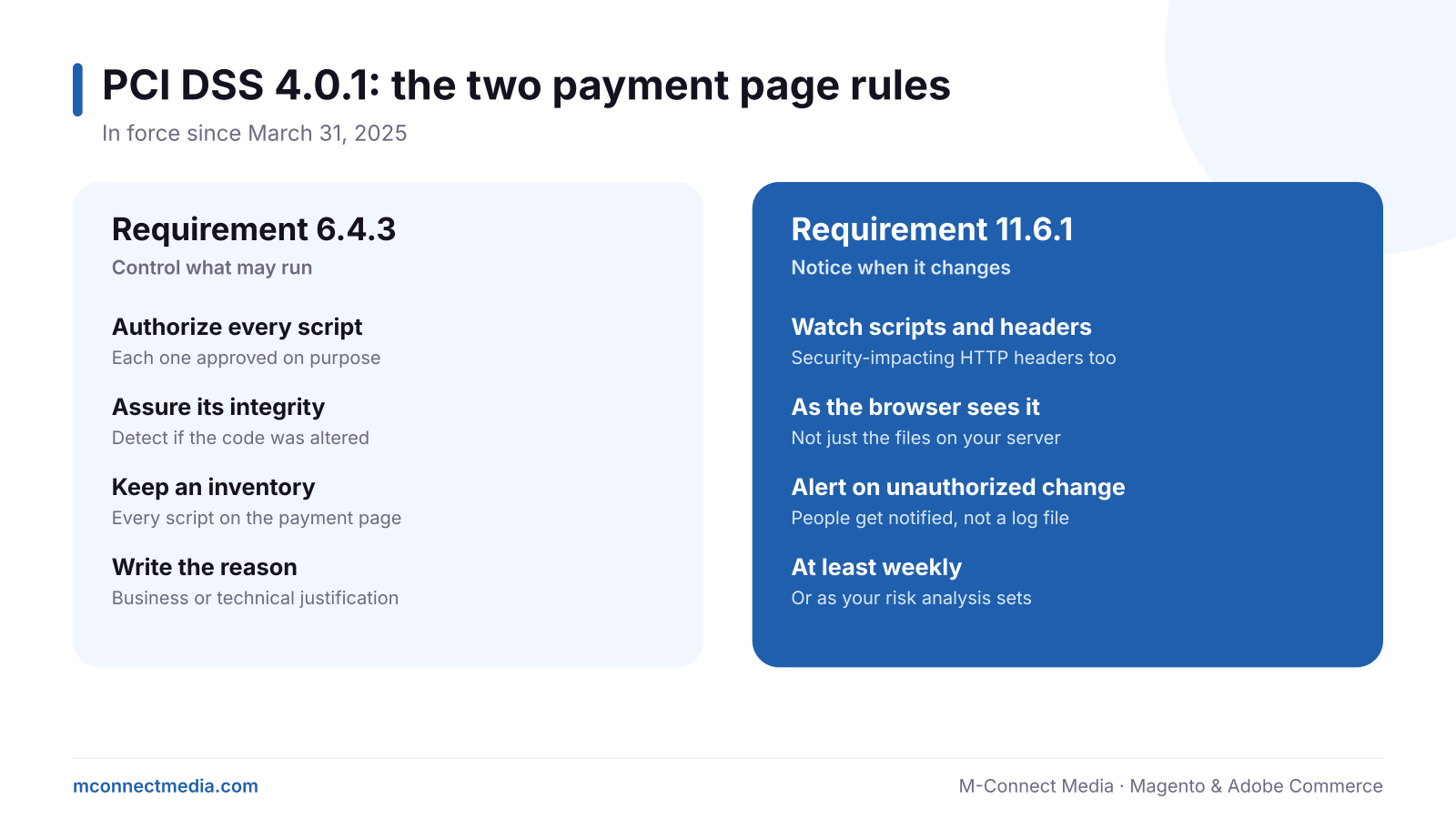
- Requirement 6.4.3: every script on the payment page must be authorized, its integrity must be assured, and you must keep an inventory of all scripts with a written business or technical justification for each.
- Requirement 11.6.1: a mechanism must alert you to unauthorized changes to the security-impacting HTTP headers and the script contents of payment pages, as the shopper’s browser receives them. It must run at least weekly, or at a frequency set by your own risk analysis.
Note the words “as received by the consumer browser”. Checking the files on your server is not enough. The check has to look at the page the shopper actually gets.
The 2025 change for SAQ A merchants
In January 2025, the PCI Security Standards Council removed requirements 6.4.3 and 11.6.1 from the SAQ A questionnaire, the short self-assessment used by merchants who fully outsource payment pages. In their place, SAQ A merchants must confirm their site “is not susceptible to attacks from scripts that could affect the merchant’s e-commerce system(s).”
That is not a free pass. The Council says the change affects how merchants report, not the underlying security requirements. If your Magento checkout embeds a payment form or loads scripts on the page that hosts it, you still need to show those scripts cannot be abused. Which questionnaire applies to you is a question for your acquirer or a qualified assessor. We are not one, and neither is a blog post.
What Magento already gives you
- Subresource Integrity (SRI) on payment pages. According to Adobe’s developer documentation, Magento Open Source and Adobe Commerce 2.4.7, 2.4.8 and later (and patch releases 2.4.4-p9, 2.4.5-p8 and 2.4.6-p6) add integrity hashes for scripts on payment pages, to support PCI 4.0 script integrity checks.
- Content Security Policy (CSP). Magento ships a CSP module that controls which domains may load scripts. On checkout, a strict policy blocks scripts that are not on the allowed list.
These help with 6.4.3, but they do not write your inventory or justification for you, and they do not give you weekly change alerts for 11.6.1. Third-party scripts loaded from outside domains also need their own decisions.
Build your script inventory in an afternoon
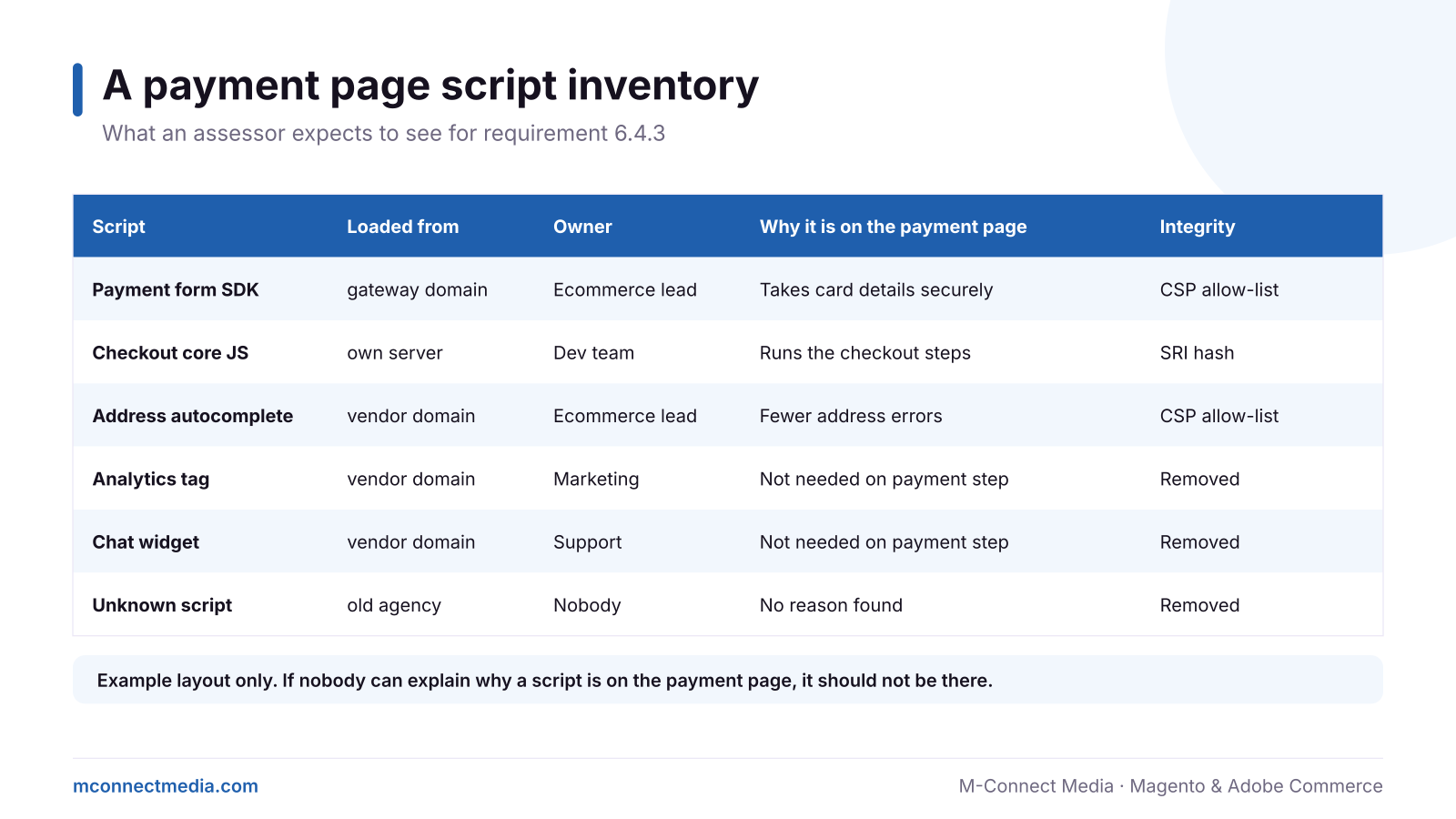
- List what loads. Open the checkout and payment step with browser developer tools and record every script, including ones loaded by other scripts.
- Give each one an owner and a reason. If nobody can explain why a script is on the payment page, remove it from that page.
- Remove what is not needed. Marketing pixels and chat widgets rarely need to run on the payment step.
- Lock down the rest. Use SRI for scripts you host, a strict CSP for allowed domains, and a review step before anyone adds a new script.
- Set up change detection. Use a monitoring tool that loads the payment page as a browser does and alerts on script or header changes. Weekly is the minimum; more often is safer.
Not sure what runs on your payment page?
My team’s Magento security audit includes a payment page script inventory, CSP and SRI review, and a monitoring plan you can hand to your assessor.
FAQ
Do PCI DSS 6.4.3 and 11.6.1 apply to Magento stores?
They apply to the payment pages of merchants in scope for those requirements. Many Magento stores are, especially those that host or embed the payment form. Your acquirer or assessor confirms which questionnaire and requirements apply.
Is a passing vulnerability scan enough?
No. A scan checks your server for known weaknesses. These requirements are about the scripts running in the shopper’s browser on the payment page, which a scan does not cover.
Does Magento 2.4.7 make my store PCI compliant?
No version makes a store compliant by itself. Newer versions add SRI and CSP support that helps, but compliance depends on your whole setup, processes and evidence.
Sources
- PCI SSC: Important updates for merchants validating to SAQ A
- DeepStrike: PCI DSS 6.4.3 and 11.6.1 explained
- Adobe Commerce: Subresource Integrity