Short answer: in late 2025 a critical Magento bug called SessionReaper was fixed by Adobe, but most stores did not apply the fix. Six weeks later, automated attacks hit a large share of all Magento stores. The lesson is simple: a Magento security patch only protects you once it is installed.
Picture a store owner on a Thursday morning in late October 2025. Sales look normal. The admin works. Nobody on the team has touched the server in weeks. What the owner does not know is that a stranger’s script visited the store overnight, sent one crafted request to the REST API, and left a small file behind.
That file is a backdoor. It does nothing visible for days. Then, one evening, the checkout page starts loading an extra script that copies card details as customers type them.
This scene is illustrative, but it matches what security researchers reported as SessionReaper (CVE-2025-54236) moved from “fixed” to “mass exploited” in a few days.
What SessionReaper was, in plain language
SessionReaper was a flaw in how Magento and Adobe Commerce handled certain input through the REST API. In the worst case it let an attacker take over customer sessions and run code on the server without logging in. It was rated 9.1 out of 10 for severity.
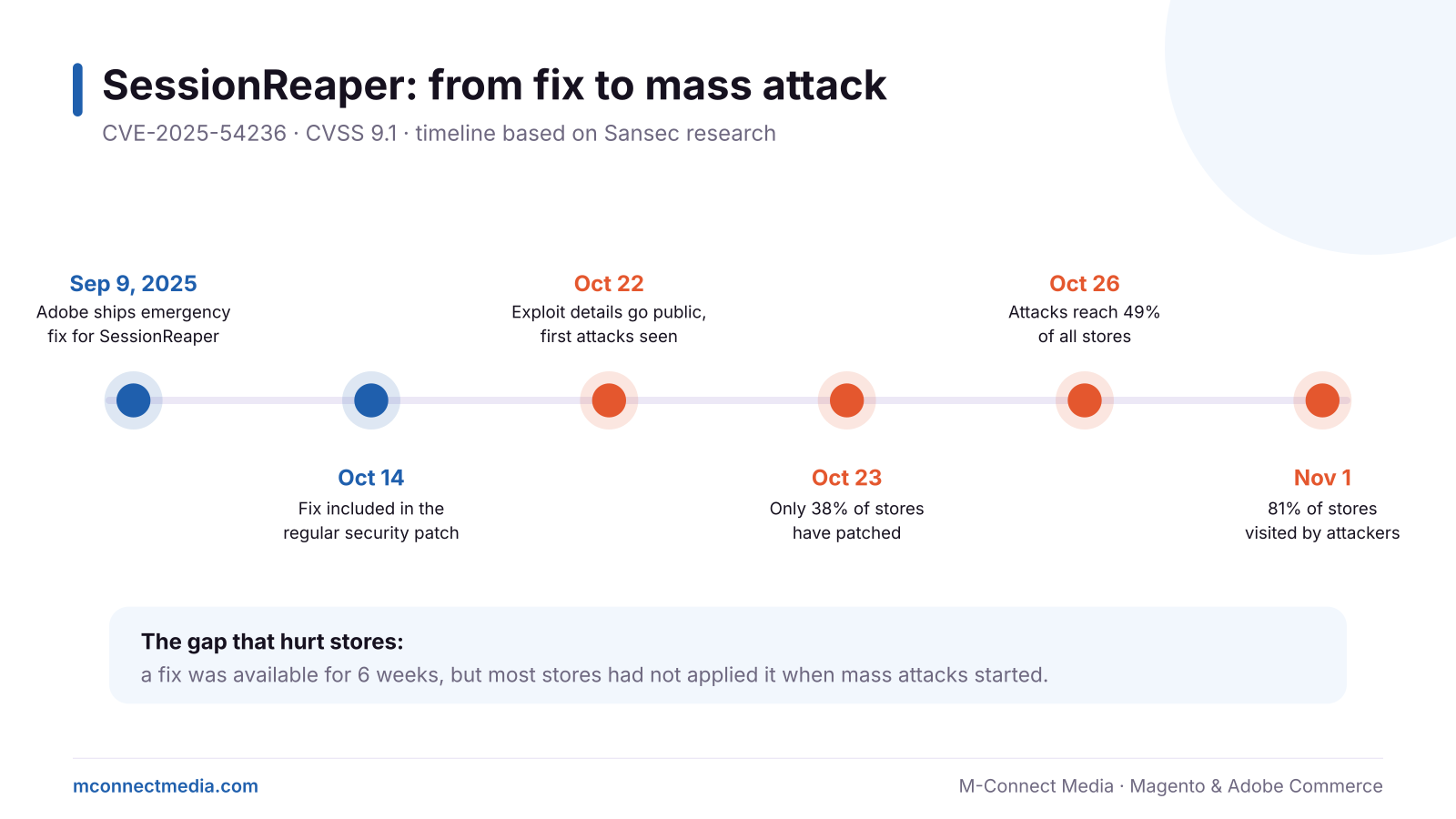
Adobe released an emergency fix on September 9, 2025, and folded it into the regular Magento security patch on October 14. So the fix existed. The problem was everything that happened next.
The six weeks nobody used
According to Sansec’s research, the turning point came on October 22, when a technical analysis of the bug was published. Attacks started the same day.
Here is what the following days looked like, based on their tracking:
- October 23: only about 38% of stores had applied the fix.
- October 24: attacks had reached roughly 31% of all Magento stores, and Adobe raised the patch priority to “apply within 72 hours”.
- October 26: about half of all stores had been hit, with an estimated 16% to 18% carrying at least one backdoor.
- November 1: around 81% of stores had been visited by SessionReaper probes.
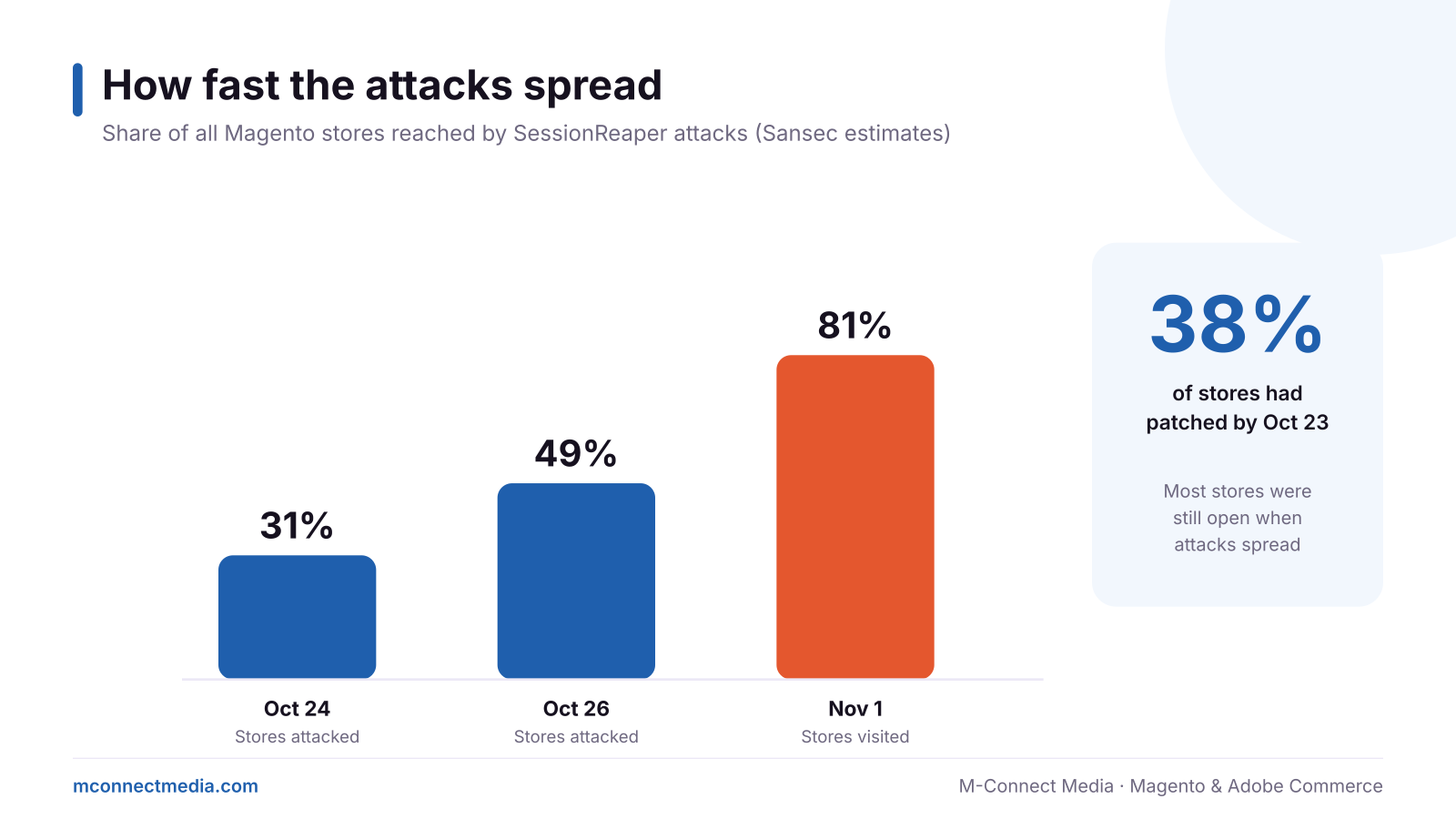
Read that again: the fix was available for six weeks before the attacks, and most stores still had not installed it.
Why good store owners skip patches
In our experience, owners rarely ignore security on purpose. Patches get skipped for very ordinary reasons:
- “Nothing is broken.” The store works, so the patch feels optional.
- Fear of breaking something. An old extension failed after the last update, so everyone is nervous.
- No owner for the task. The original developer moved on and nobody checks Adobe’s security bulletins.
- Unsupported versions. Stores on old 2.4.x lines may not get a patch at all, which turns a 30-minute job into an upgrade project.
Every one of these is fixable. None of them is fixable during an active attack. If nobody on your side owns patching today, our Magento support services team can take it off your plate.
The Magento security patch routine we recommend to every store
Since 2026, Adobe releases security fixes on a monthly schedule (the second Tuesday of each month), on top of one big platform release each May. That actually makes life easier, because you can plan for it:
- Know your exact version. Run
bin/magento --versionand write it down. Check it is still in Adobe’s support window. - Watch the bulletin day. Put the second Tuesday of every month in a calendar with a named person responsible.
- Apply on staging first. Install the patch on a copy of the store, then test search, cart, checkout and payments.
- Ship within days, not months. For critical bugs, aim for 72 hours. That was Adobe’s own guidance for SessionReaper once attacks began.
- Add a safety net. A web application firewall and file-change monitoring catch attacks that slip through the gap.
How to tell if your store was already hit
If you are not sure you patched in time, assume you need a check. Warning signs include unknown PHP files in public folders, new admin users nobody created, unexpected scripts on checkout pages, and customers reporting card fraud after buying from you. A malware scan alone is not enough, because backdoors are often designed to look like normal Magento files. A proper Magento security audit checks code, admin users and checkout scripts, not just files.
Not sure your store is clean or patched?
Our team at M-Connect Media runs a full Magento security audit: version and patch status, backdoor and malware check, admin user review and checkout script inventory. You get a clear report with what to fix first.
FAQ
Is SessionReaper still a risk today?
Yes, for any store that never applied the fix or runs a version that no longer gets security patches. Automated scanners keep trying old bugs for years.
Does Magento Open Source get the same patches as Adobe Commerce?
Security patches are released for both, but Open Source stores only get them while their version line is in regular support. There is no extended support for Open Source.
How long does a Magento security patch take to apply?
On a well-maintained store, usually a few hours including testing. On a store with outdated extensions it can take longer, which is exactly why staying current matters.
Sources
- Sansec: SessionReaper, unauthenticated RCE in Magento and Adobe Commerce
- Sansec: SessionReaper attacks have started
- Monthly security patch schedule (second Tuesday) from 2026