
Short answer: Is Magento dying? It is shrinking, but it is not dying. The number of live stores is falling, while support for the latest version runs to May 2029 and the main fast frontend is now free. Stores with complex catalogs, B2B rules or deep integrations usually do best staying. Small, simple stores with a small team often do better on a hosted platform. Decide on three years of total cost, not on headlines.
An owner calls with a straight question. “My developer says Magento is dying. A Shopify agency says I can move in six weeks. Should I leave?”
It is a fair question, and an agency that builds on Magento has an obvious bias. So here is the honest version, including the cases where our answer is yes, leave.
The facts first
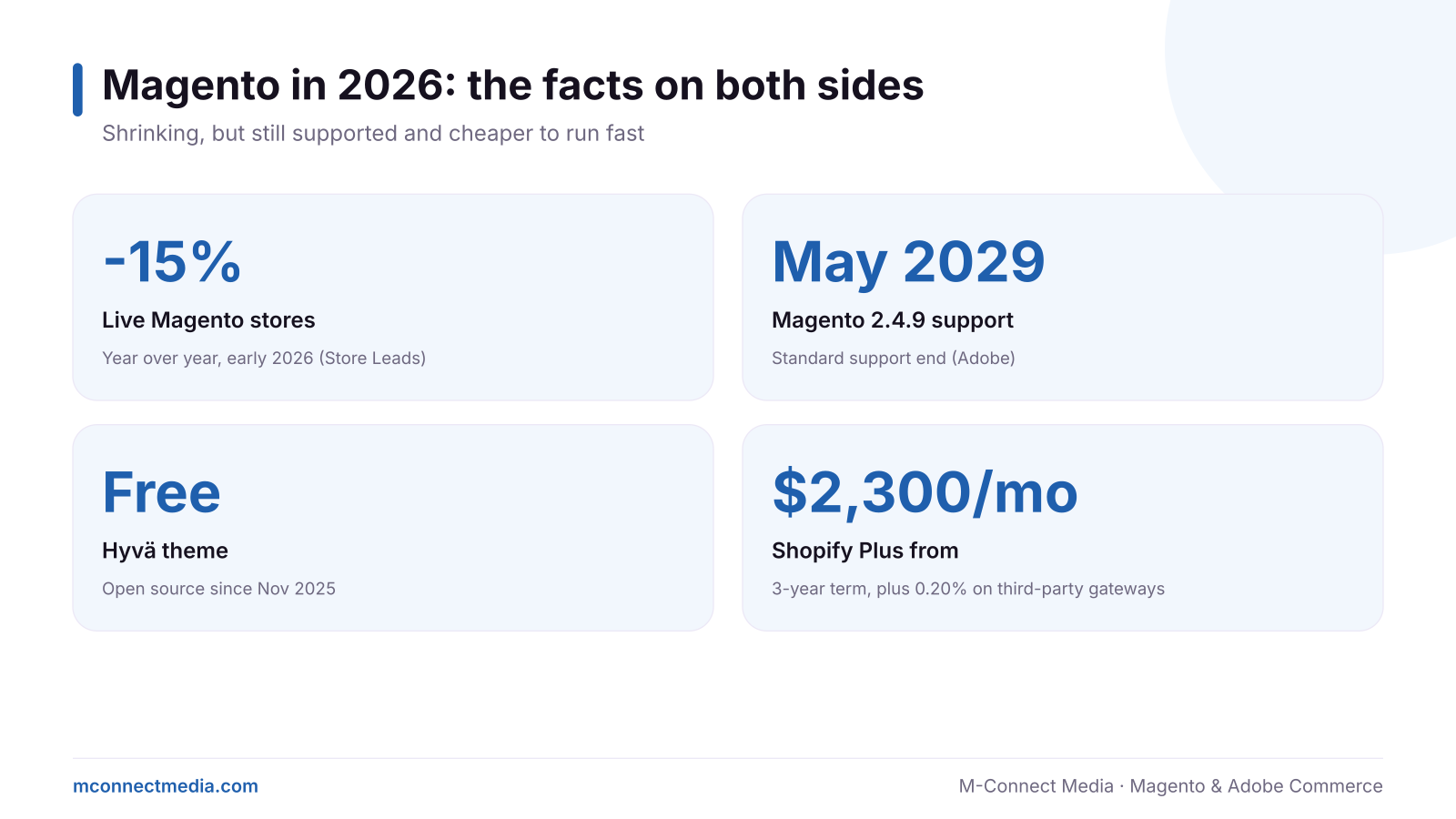
- The store count is falling. Store Leads data shows Magento lost about 15% of its live stores year over year heading into early 2026. Many leavers went to Shopify Plus.
- The platform is still maintained. Magento 2.4.9 was released in May 2026 and is supported until May 31, 2029, with monthly security patches.
- The frontend got cheaper. The Hyvä theme became free and open source in November 2025, which cuts the cost of a fast storefront.
- The alternative is not free either. Shopify Plus starts at about $2,300 per month on a three-year term, with an extra 0.20% per transaction if you use a third-party payment gateway, plus app subscriptions.
When we tell owners to stay
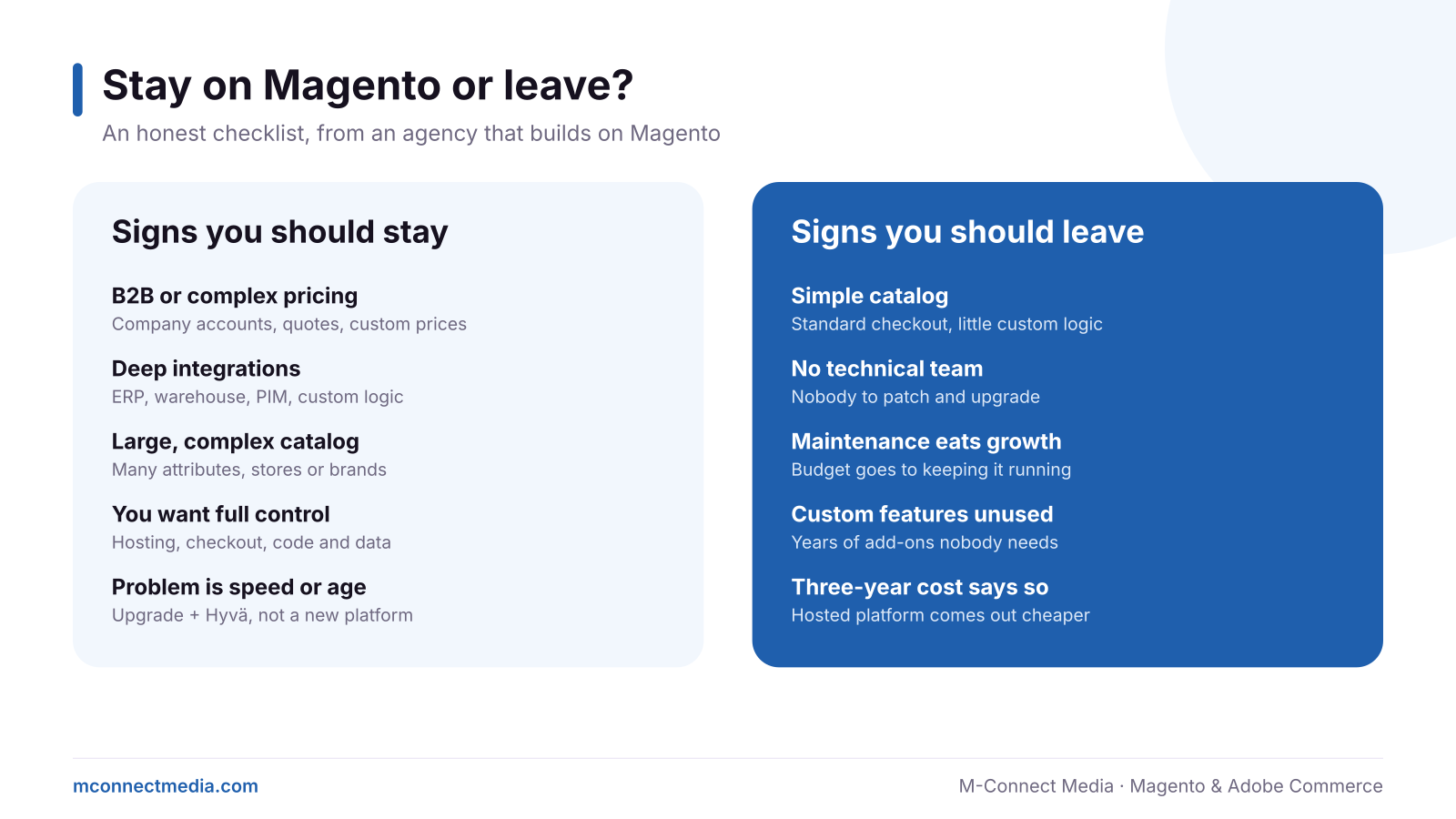
- B2B and complex pricing. Customer-specific prices, quotes, company accounts and approval flows.
- Deep integrations. ERP, warehouse, PIM and custom logic that would need to be rebuilt elsewhere.
- Large or complex catalogs. Many attributes, configurable products and several store views or brands from one admin.
- Owning your code and data matters. You want control over hosting, checkout and every line of logic.
- The real problem is speed or age. A slow Luma store on an old version often needs an upgrade and Hyvä, not a new platform.
When we tell owners to leave
- A simple catalog and standard checkout. Little custom logic and few integrations.
- No technical team. Nobody in-house to manage hosting, patches and upgrades, and no budget for ongoing support.
- Maintenance is eating the growth budget. Most spending goes to keeping the store running rather than improving it.
- The custom features are not used. Years of add-ons that nobody needs any more.
How to decide without guessing
- List what the store actually does. Every integration, custom rule and extension in use today.
- Add up three years on each platform. Licence or plan fees, hosting, apps or extensions, transaction fees, support, and the one-time cost of moving or upgrading.
- Price the move honestly. Data migration, redirects to protect SEO, rebuilding custom features, retraining staff and the risk of a launch dip.
- Compare against fixing what you have. An upgrade plus Hyvä is the real alternative to a move, not “do nothing”.
Sometimes the numbers say leave, and we will say so. A partner who only ever gives one answer is not giving advice.
Want a straight answer for your store?
My team’s ecommerce consulting services include a platform review: what you use, what it costs over three years on each option, and a clear recommendation, even if that means leaving Magento.
FAQ
Is Magento dying?
No. Its store count is shrinking, but Adobe still releases versions and monthly security patches, with 2.4.9 supported to May 2029, and the community Mage-OS project is active.
Is Shopify Plus cheaper than Magento?
It depends on the store. Shopify Plus has a fixed monthly fee and possible transaction and app costs. Magento has hosting, development and support costs. Compare three-year totals for your own setup.
Will moving platforms hurt my SEO?
It can if URLs change without proper redirects. A careful migration with a full redirect map and content carried over keeps most rankings.
Sources
- Ringly: Replatforming from Magento (Store Leads data)
- Elogic: Shopify Plus pricing 2026
- Hyvä: Hyvä Theme is now open source and free
- Adobe Commerce: Software lifecycle policy