Short answer: AI assistants like ChatGPT recommend products they can read and trust. Pages with specific titles, real attributes, product schema, honest stock and price data, real FAQ answers and marked-up reviews get picked. Thin pages with vague titles get skipped, even when the product is better or cheaper.
Two stores sell the same pair of trail shoes at nearly the same price. A shopper asks an AI assistant: “Best waterproof trail shoes for wide feet under $100?”
The assistant recommends one store and never mentions the other.
The losing store did nothing wrong in the old sense. It ranks on Google. Its photos are good. But its product page says “TRP-26 Black, great for outdoor adventures” and lists the width, waterproofing and weight inside a long paragraph. The winning page says it plainly, in structured fields, with an FAQ that answers the wide-feet question directly.
The shopper now starts with a question
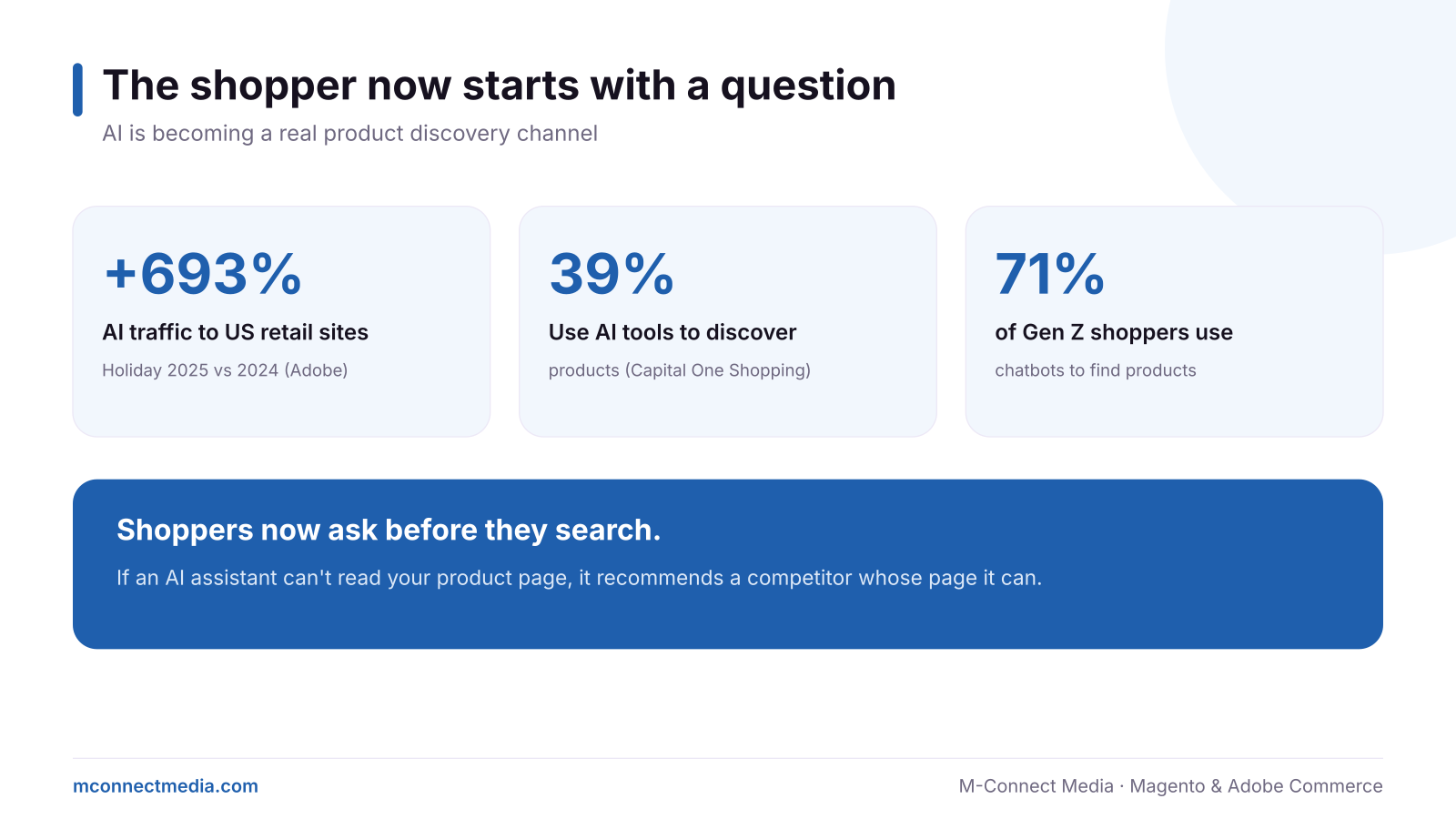
The numbers moved fast. Adobe reported that traffic from generative AI tools to US retail sites rose 693.4% in the 2025 holiday season compared with 2024. Survey data cited by Hello Retail from Capital One Shopping (2026) says 39% of shoppers use AI tools for product discovery, and 71% of Gen Z shoppers use chatbots to find products.
This work has a name: generative engine optimization, or GEO. It is SEO’s younger sibling. SEO asks “how do I rank?” GEO asks “how do I become the answer the AI gives?”
Why AI skips most product pages
Adobe’s own retail analysis found that many retail pages, product pages especially, are not fully machine-readable. AI tools pull facts from your page, your structured data and your feeds. When those are vague, missing or contradict each other, the AI plays safe and picks a store whose facts are clear.
Five fixes that get ChatGPT shopping product pages picked
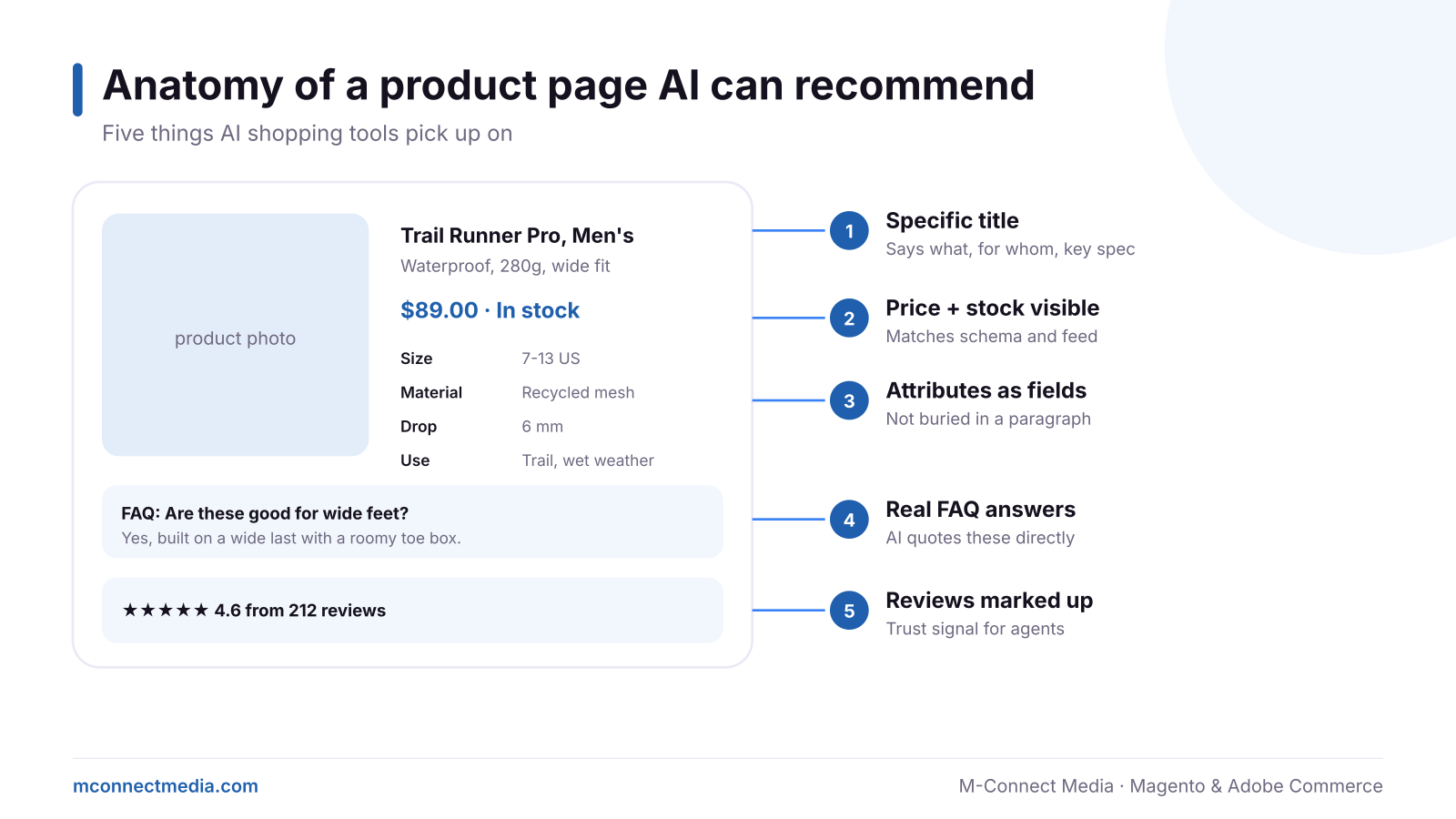
1. Write specific titles
Say what it is, who it is for and the key spec: “Trail Runner Pro, Men’s Waterproof Trail Shoe, Wide Fit”. Model codes can stay, but not alone.
2. Keep price and stock consistent everywhere
The price on the page, in your schema markup and in your product feed must match. Mismatches are one of the fastest ways to lose an AI’s trust.
3. Store attributes as real fields
Size range, material, weight, fit and use case belong in Magento attributes, shown in a specification table, not buried in a description. Magento is very good at this. Many stores simply never set it up. Our Magento developers can set it up for your catalog.
4. Answer real questions in an FAQ
Use the questions customers actually ask your support team. “Are these good for wide feet?” with a direct answer is exactly the kind of sentence an AI assistant quotes.
5. Mark up reviews and ratings
Reviews in structured data give AI tools a trust signal. Real reviews only: fake ones are a legal and reputation risk.
Start with your top 50 products
You do not need to fix 10,000 SKUs on day one. Take your 50 best sellers, apply the five fixes, and watch where AI referral traffic and conversions move. Then roll the pattern out across the catalog, with AI tools helping to enrich the data at scale under human review. Our Magento AI development team can run this enrichment for you.
Get your products recommended by AI
M-Connect Media’s AI for Magento service covers product data enrichment, schema markup, AI search optimization and agent-ready catalog setup, built on your existing Magento store.
FAQ
Is GEO different from SEO?
They overlap a lot. Good technical SEO is still the foundation. GEO adds clearer structure, direct answers and consistent data so AI tools can quote you accurately.
Can I track traffic from ChatGPT and other AI tools?
Partly. Many AI tools send referral traffic you can see in analytics, but some answers lead to no click at all. Track AI referrals and branded searches together.
Do I need a special extension for this?
Not to start. Titles, attributes, schema and FAQs can be done in standard Magento. Extensions help later with feeds, llms.txt and agent access.
Sources
- Adobe: 2025 holiday shopping season and AI traffic
- Hello Retail: GEO for ecommerce (Capital One Shopping and Adobe data)